 Dec, 12 2025
Fuel Efficiency Impact Calculator
See how much you're losing with bad spark plugs. Modern vehicles can lose 15-30% fuel efficiency when spark plugs are failing. Calculate your potential savings from replacement.
Typical range for bad spark plugs
Your Potential Savings
With bad spark plugs, you're losing of your fuel efficiency.
Current Monthly Fuel Cost: $
Estimated Monthly Fuel Cost with Bad Spark Plugs: $
Monthly Savings if Replaced:
Annual Savings:
Driving with bad spark plugs isn’t just risky-it’s like trying to run a marathon with one shoe missing. You might make it a few blocks, but you’ll pay for it later. Spark plugs are small, but they’re the heartbeat of your engine. If they’re worn, cracked, or fouled, your car won’t run right. And ignoring the signs won’t make them better-it’ll just cost you more.
What Happens When Spark Plugs Go Bad?
Spark plugs ignite the air-fuel mixture in your engine’s cylinders. When they start failing, that ignition gets messy. You’ll notice it first in how the car drives. A misfire feels like a hiccup-your engine stutters, especially when accelerating or climbing hills. It’s not just annoying. It means fuel isn’t burning properly, which leads to wasted gas and higher emissions.
Modern cars have sensors that catch this. Your check engine light might come on, often with a code like P0300 (random misfire) or P0301-P0308 (cylinder-specific misfire). These codes point directly to spark plug issues. But even if the light stays off, your car’s performance will drop. You’ll feel less power. The idle might shake. Fuel economy can drop by 15% to 30%-that’s $50 to $100 extra per month if you drive regularly.
Common Signs of Failing Spark Plugs
- Engine misfires: Sudden jerks or hesitation when you press the gas.
- Hard starting: The engine cranks longer than usual, especially in cold weather.
- Reduced fuel efficiency: You’re filling up more often without changing your driving habits.
- Unstable idle: The car shakes when stopped at a light.
- Sluggish acceleration: The car feels slow to respond, even when you push the pedal down.
- Check engine light: Often triggered by misfires linked to spark plug failure.
These symptoms don’t always show up all at once. Sometimes, you’ll just feel like your car isn’t as peppy as it used to be. That’s the quiet warning before things get worse.
Can You Really Drive With Bad Spark Plugs?
Technically, yes-you can. But you shouldn’t. Most cars will keep running with one or two bad spark plugs, but they’re running on borrowed time. The engine compensates by adjusting fuel delivery and timing, but that puts extra strain on other parts.
Here’s what happens if you keep driving:
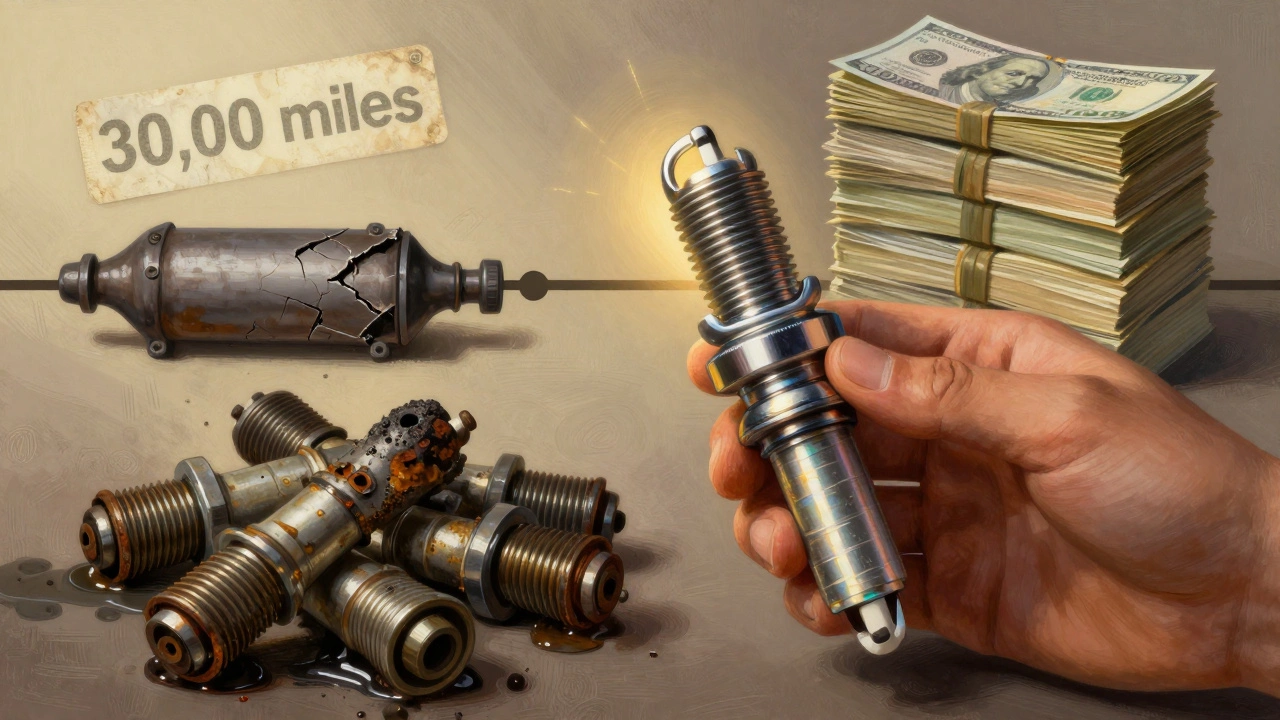
- Catalytic converter damage: Unburned fuel flows into the exhaust system. That overheats the converter, which can cost $1,000 to replace.
- Oil contamination: Poor combustion leaves carbon deposits that mix with engine oil, reducing its effectiveness.
- Increased emissions: Your car will fail emissions tests easily. In places like Ontario, that means no registration renewal.
- Engine damage: Long-term misfires can warp valves or damage pistons. That’s not a $100 fix-it’s a $2,000+ repair.
One study from the Society of Automotive Engineers found that vehicles driven 500+ miles with bad spark plugs had a 40% higher chance of secondary engine damage compared to those replaced on schedule.

How Long Can You Drive Before It’s Dangerous?
There’s no magic number. If your spark plugs are just starting to fail-maybe you’ve got a slight misfire-you might get another 100 to 200 miles before things get serious. But if they’re completely dead in one or more cylinders, you’re already damaging your car.
Think of it like this: driving with bad spark plugs is like ignoring a leaky pipe. At first, it’s just a drip. Then the floor rots. Then the ceiling collapses. The longer you wait, the worse the damage.
Most manufacturers recommend replacing spark plugs every 30,000 to 100,000 miles, depending on the type. Standard copper plugs last 30,000-40,000 miles. Platinum and iridium plugs can go 60,000-100,000 miles. If you’re past that range and haven’t replaced them, you’re already in danger zone.
What to Do If You Suspect Bad Spark Plugs
Don’t guess. Check.
- Read the check engine light: Use an OBD2 scanner-many auto parts stores offer free scans. Look for misfire codes.
- Inspect the plugs: Remove one or two (if you’re comfortable). Look for black soot (rich fuel), white deposits (overheating), or cracked porcelain. Worn electrodes mean it’s time.
- Check your service history: When were they last replaced? If it’s been more than 60,000 miles and you don’t know, assume they’re overdue.
- Get a second opinion: A mechanic can do a compression test or ignition scope check to confirm the issue.
Replacing spark plugs is one of the cheapest and easiest fixes in car maintenance. A set of iridium plugs costs $40-$80. Labor is usually $100-$150 if you don’t do it yourself. Compare that to a $1,200 catalytic converter replacement. The math is obvious.
What Type of Spark Plugs Should You Use?
Don’t just grab the cheapest ones. Your car’s manual specifies the right type. Using the wrong plug can cause overheating or poor performance.
Here’s what to look for:
- Copper: Inexpensive, good for older cars. Short lifespan (30k-40k miles).
- Platinum: Lasts longer (60k-100k miles). Better for modern engines.
- Iridium: Best performance and longevity (up to 120k miles). Ideal for turbocharged or high-efficiency engines.
Most cars made after 2010 use platinum or iridium. If you’re replacing them, go with the type your car was designed for. Upgrading to iridium isn’t a bad idea-it’s a long-term investment.
Can You Replace Spark Plugs Yourself?
Yes. Most people can do it in under an hour with basic tools: a spark plug socket, ratchet, torque wrench, and gap tool. You’ll need to disconnect the battery, remove ignition coils or wires, and pull out each plug one at a time. Don’t mix up the order. Tighten them to the torque spec in your manual-over-tightening can crack the threads in the cylinder head.
Pro tip: Use anti-seize on the threads only if your manual says it’s okay. Some manufacturers warn against it. Always use a torque wrench. Guessing the tightness is how people strip cylinder heads.
If you’ve never done it before, watch a video for your exact car model. YouTube has step-by-step guides for almost every vehicle on the road.
What If You Ignore It?
Ignoring bad spark plugs doesn’t save money. It just delays the inevitable. You’ll burn more fuel. You’ll stress your engine. You’ll risk a breakdown on the highway. And you’ll eventually pay thousands to fix what could’ve been fixed for $150.
It’s not just about your wallet. In Hamilton, where winters are harsh and roads are icy, a misfiring engine can leave you stranded. Imagine pulling out of your driveway and the car sputters to a stop. That’s not a minor inconvenience-it’s a safety risk.
There’s no benefit to waiting. The only question is: how much damage are you willing to accept before you act?
Final Advice
Replace spark plugs on schedule. If you’re unsure when they were last changed, assume they’re overdue. Don’t wait for the check engine light. Don’t wait for the car to shake. Don’t wait for the fuel bill to spike.
Spark plugs are cheap. The damage they cause if ignored is not.
Can bad spark plugs cause a car to stall?
Yes. If one or more spark plugs fail completely, the engine can misfire badly enough to stall, especially at idle or under load. This is common in older cars with worn plugs or when moisture gets into the ignition system.
Will bad spark plugs trigger the check engine light?
Almost always. Modern cars detect misfires and store diagnostic codes like P0300-P0308. The check engine light will turn on within minutes of a consistent misfire. Sometimes it flashes, which means severe damage is happening right now.
How often should spark plugs be replaced?
Standard copper plugs every 30,000-40,000 miles. Platinum plugs every 60,000-80,000 miles. Iridium plugs can last up to 100,000-120,000 miles. Always follow your owner’s manual. If you drive in stop-and-go traffic or short trips, replace them sooner-carbon buildup happens faster.
Can I drive with one bad spark plug?
You can, but you shouldn’t. Even one bad plug causes uneven combustion, which strains the engine, wastes fuel, and can damage the catalytic converter over time. It’s not a temporary fix-it’s a ticking clock.
Do spark plugs affect gas mileage?
Yes, significantly. Worn or fouled spark plugs can reduce fuel economy by 15% to 30%. That means if you normally get 30 mpg, you could drop to 21 mpg. Over a year, that’s hundreds of dollars extra in fuel.
Are expensive spark plugs worth it?
For most modern cars, yes. Iridium and platinum plugs last longer and provide more consistent ignition. They’re especially worth it if you drive long distances, have a turbocharged engine, or want to avoid frequent replacements. The upfront cost pays off in reliability and fuel savings.