 Aug, 28 2026
Alloy Wheel Repair vs. Replace Calculator
Enter your details to see if you should repair or replace your wheel.
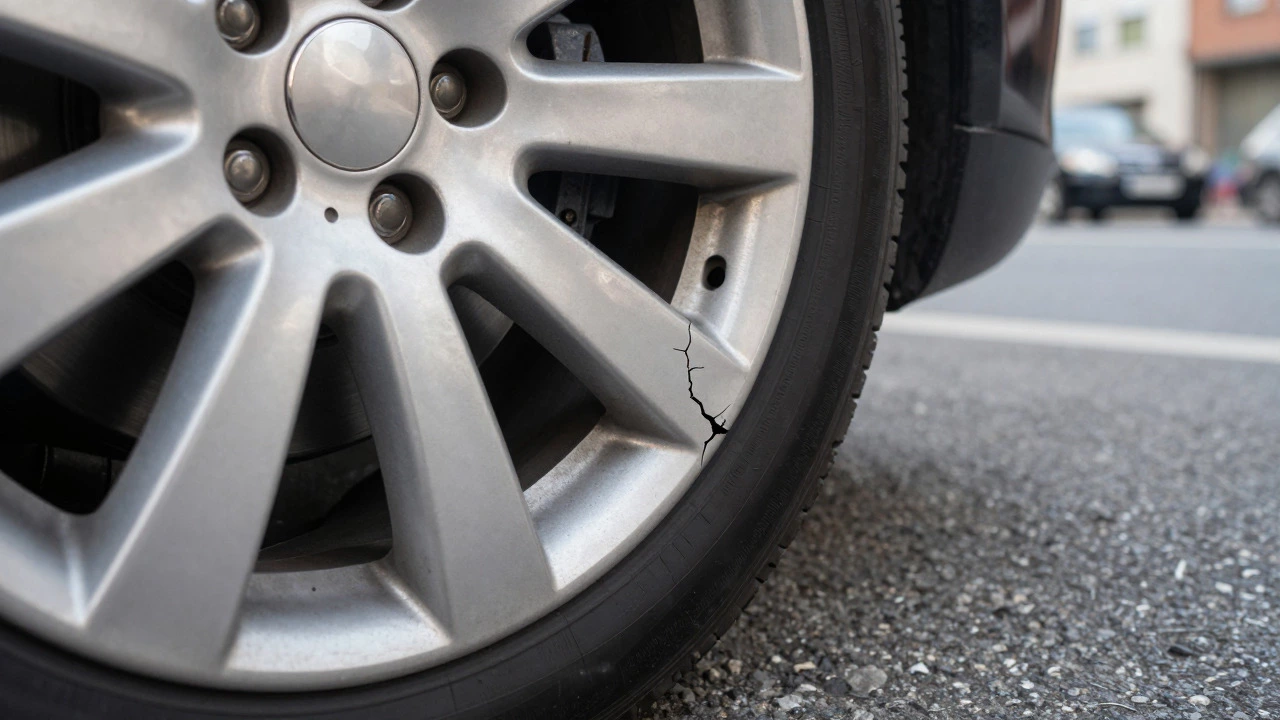
You’re driving down a pothole-riddled street in Hamilton, and you hear that sickening thud. Your heart skips a beat. You pull over, look at your tire, and see it’s still holding air. Relief washes over you-until you notice the jagged line running across the face of your shiny metal rim. Is this just cosmetic damage, or is your wheel about to explode on the highway?
This is the million-dollar question for anyone who loves the look of their car but hates the cost of replacing parts: Alloy wheels, also known as aluminum or magnesium wheels, are significantly more prone to cracking than traditional steel rims. While they offer better performance and aesthetics, their structural integrity relies on complex casting or forging processes that create specific weak points under stress. Unlike steel, which bends and dents when abused, alloy tends to fracture. Understanding why this happens-and how to spot it before it becomes dangerous-is crucial for keeping your ride safe and your wallet intact.
Why Alloy Wheels Are More Fragile Than Steel
To understand the risk, you have to look at the material science behind the wheel. Most modern cars come with alloy wheels because they are lighter than steel. This reduction in unsprung weight improves handling, acceleration, and braking efficiency. But there is a trade-off. Steel is ductile; it can deform plastically without breaking. If you hit a curb hard enough on a steel wheel, it might bend out of shape, but it will likely hold together. Aluminum alloys, however, are brittle by nature. They have high strength-to-weight ratios but lower tolerance for sudden impact energy.
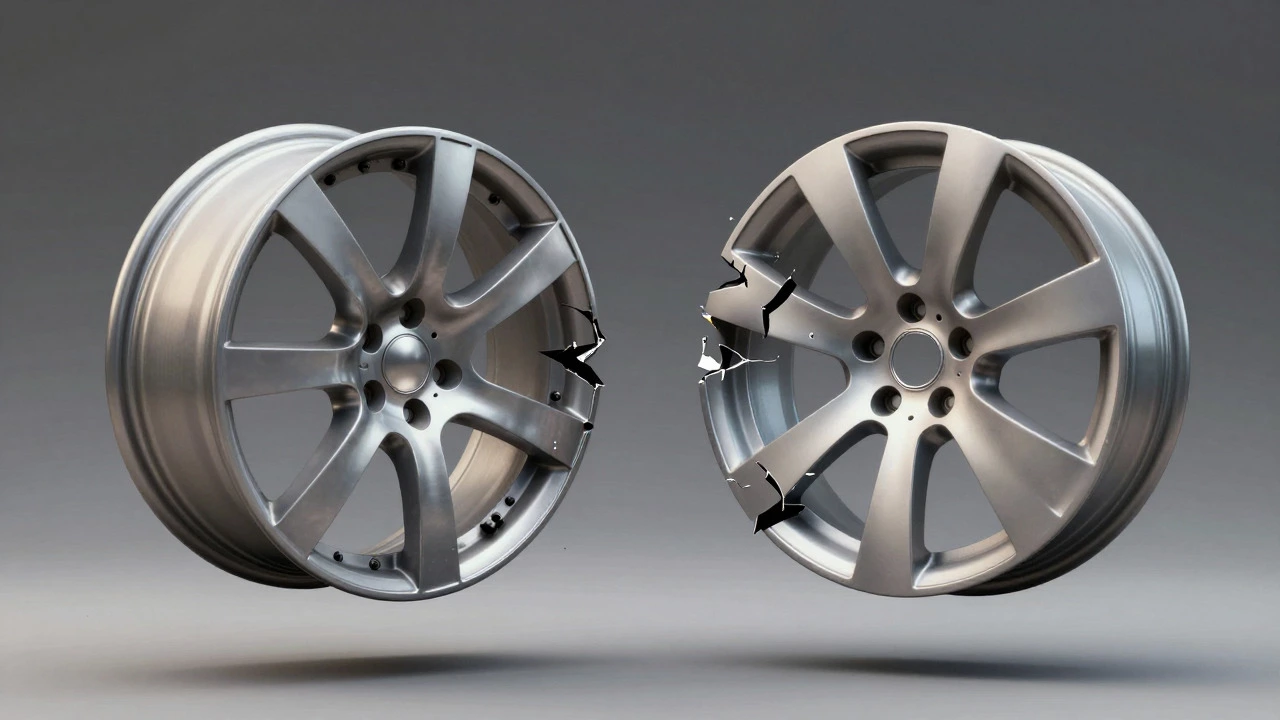
When an alloy wheel hits a deep pothole or slams into a curb, the energy has nowhere to go but into the metal structure itself. Instead of bending, the metal reaches its elastic limit and snaps. This creates a crack. In severe cases, the wheel can shatter completely. The type of alloy matters, too. Cast aluminum wheels, which are made by pouring molten metal into a mold, are cheaper and more common but contain microscopic air bubbles that act as stress concentrators. Forged aluminum wheels are denser and stronger, making them less likely to crack under similar conditions, but they are also far more expensive.
| Feature | Cast Alloy Wheels | Forged Alloy Wheels | Steel Wheels |
|---|---|---|---|
| Crack Resistance | Low to Moderate | Moderate to High | Very High (Bends instead) |
| Impact Behavior | Fractures/Cracks | May chip or crack | Dents/Bends |
| Repairability | Difficult (Welding required) | Often Irreparable | Easily Replaced |
| Cost | $100 - $300 per wheel | $400+ per wheel | $50 - $100 per wheel |
The Top 3 Reasons Alloy Wheels Crack
It’s rarely just one thing that kills a wheel. It’s usually a combination of environmental factors and physical abuse. Here are the three most common culprits.
- Potholes and Road Debris: This is the number one killer. When you hit a pothole, the force travels through the tire and directly into the wheel lip. If the tire pressure is low, the sidewall collapses more easily, transferring even more shock to the metal. A single hard impact can cause a hairline fracture that grows every time you drive.
- Curb Impacts: Parallel parking in tight city spaces is a hazard for alloy wheels. Scraping against a concrete curb doesn’t just ruin the finish; it creates a notch. This notch acts as a stress riser. Over time, normal driving vibrations expand that small scratch into a visible crack radiating from the edge.
- Corrosion and Fatigue: In colder climates like Canada, road salt is used heavily in winter. Salt gets trapped in the spokes and crevices of the wheel, causing corrosion. This weakens the metal structure from the inside out. Combined with the natural fatigue of metal cycling through hot and cold temperatures, old wheels become brittle and susceptible to spontaneous cracking, even without a major impact.
How to Spot a Cracked Wheel Before It Fails
Many drivers ignore minor wheel damage until the tire goes flat unexpectedly. But a cracked wheel can lose air slowly, leading to uneven wear, or it can fail catastrophically at speed. How do you know if your wheel is compromised?
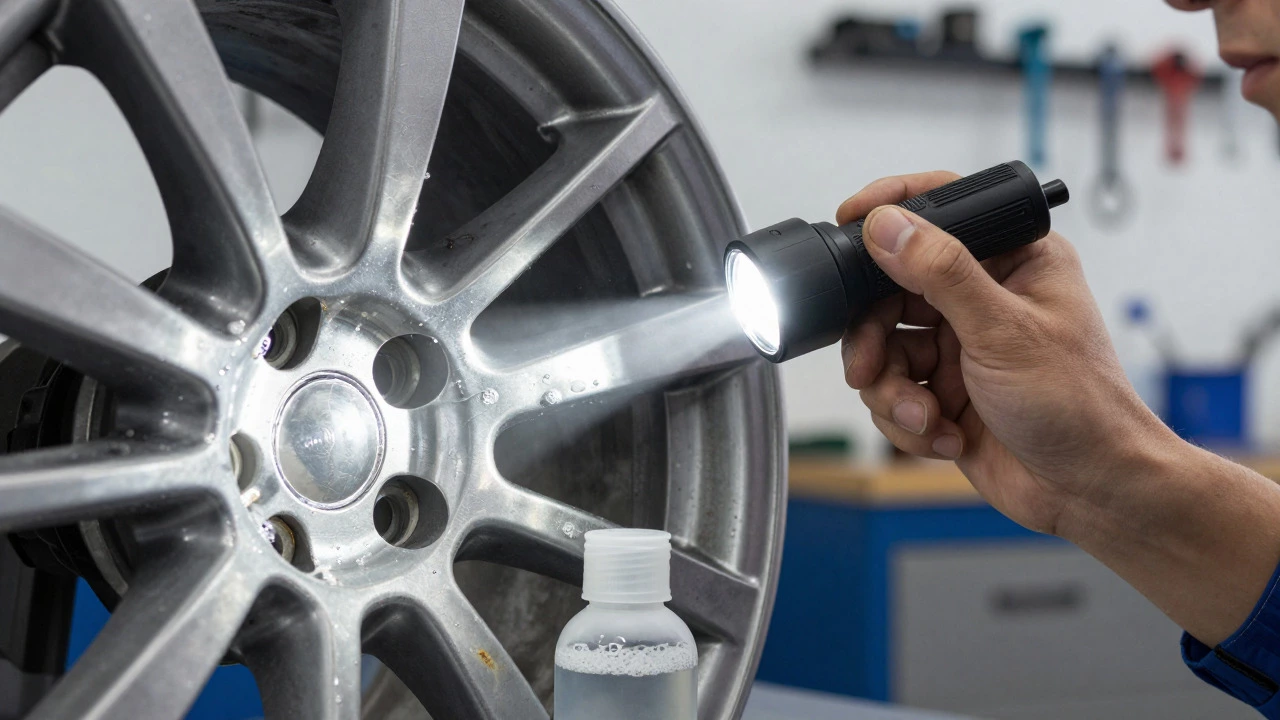
First, use your eyes. Look closely at the inner barrel of the wheel-the part hidden behind the tire. Shine a flashlight along the surface. You are looking for dark lines or spiderweb patterns. Hairline cracks often start near the valve stem or around the lug nut holes because these are high-stress areas. If you see any linear discontinuity in the metal, treat it as a crack until proven otherwise.
Second, use your ears and hands. Does your steering wheel vibrate at certain speeds? While this could be a balance issue, a bent or cracked wheel causes imbalance. Try spinning the wheel while the car is lifted. If you see a wobble or hear a clicking sound, the structural integrity is likely gone. Finally, perform a soap test. Mix dish soap with water, spray it generously over the suspected area, and watch for bubbles. Bubbles indicate escaping air, confirming that the crack has penetrated through to the interior where the tire seals.
Can You Repair a Cracked Alloy Wheel?
This depends entirely on the severity and location of the damage. Not all cracks are created equal.
Minor Surface Cracks: If the crack is superficial and only affects the clear coat or paint layer, you can often buff and repaint it. This is purely cosmetic. However, if the crack penetrates the bare metal, painting alone won’t fix the structural weakness.
Structural Cracks: If the crack goes through the metal wall, repair is possible but controversial. Specialized shops can weld aluminum wheels using TIG (Tungsten Inert Gas) welding. They clean the crack, fill it with matching filler rod, and heat-treat the wheel to restore hardness. After welding, the wheel must be machined and balanced again. The cost for this service typically ranges from $75 to $150 per wheel. Is it worth it? If you have a rare or expensive set of wheels, yes. If you have standard cast alloys, buying a used replacement might be safer and cheaper.
Irreparable Damage: Some cracks simply cannot be fixed. If the crack extends across multiple spokes, reaches the center hub, or if the wheel is forged rather than cast, repair is generally not recommended. Forged wheels have a grain structure that is altered by welding, potentially creating new weak points. Additionally, if the wheel has been previously repaired, re-welding it often leads to failure sooner than the first time.
Preventing Future Cracks: Pro Tips
You can’t avoid every pothole, but you can minimize the risk of damaging your expensive rims. Here are four practical strategies to extend the life of your alloy wheels.
- Maintain Proper Tire Pressure: Under-inflated tires provide less cushioning between the road and the wheel. Check your pressure monthly and adjust according to the manufacturer’s placard inside the driver’s door jamb. Don’t rely solely on the TPMS light; it often only triggers after significant loss.
- Avoid Potholes When Safe: Scan the road ahead. If you see a crater, slow down before you reach it, then release the brakes just before impact. Braking while hitting a hole transfers forward momentum into downward force, increasing the load on the wheel. Coasting allows the suspension to absorb some of the shock.
- Be Careful at Curbs: When parallel parking, use your side mirrors and backup camera diligently. Consider installing wheel guards or protective rings if you frequently park in tight urban spots. These plastic or rubber bands clip onto the rim edge to take the brunt of the scrape.
- Keep Wheels Clean: Wash your wheels regularly, especially during winter months. Remove brake dust and road salt buildup from the inner barrels and spoke junctions. Use a pH-neutral cleaner to avoid etching the clear coat, which protects the metal underneath from corrosion-induced fatigue.
When to Replace vs. Repair
Deciding whether to fix or replace comes down to math and safety. Calculate the total cost of repair: welding + machining + balancing + shipping if needed. Compare this to the price of a new or quality used replacement wheel. If the repair cost exceeds 50% of the replacement cost, buy a new wheel. Also, consider the age of the wheel. A ten-year-old cast alloy wheel that has been welded once is a ticking time bomb. The metal has undergone thermal cycles and fatigue. Replacing it gives you peace of mind and restores original factory specifications.
If you live in an area with poor road conditions, like many cities in Ontario, you might want to switch to steel wheels for winter tires. Steel rims are cheap, durable, and easy to replace if they get damaged. Keep your nice alloy wheels stored away during the harsh winter months, protecting them from salt and potholes. This simple swap saves thousands of dollars over the lifespan of your vehicle.
Is it safe to drive on a cracked alloy wheel?
Driving on a cracked alloy wheel is risky. If the crack is small and not leaking air, you might make it home slowly. However, the crack can spread rapidly due to vibration and heat. At highway speeds, the centrifugal force can cause the wheel to fail completely, leading to a blowout or loss of control. Always inspect the wheel immediately and consult a professional before continuing long-distance travel.
How much does it cost to repair a cracked alloy wheel?
Professional alloy wheel repair typically costs between $75 and $150 per wheel. This includes cleaning, welding the crack, machining the surface smooth, and rebalancing the wheel. Costs vary based on the size of the wheel, the complexity of the design, and the geographic location of the shop.
Can all alloy wheels be repaired?
No. Cast alloy wheels are generally repairable via welding. Forged alloy wheels are often not recommended for repair because the welding process can compromise their unique grain structure and strength. Additionally, if the crack extends into the center bore or across multiple spokes, the wheel is usually considered irreparable and must be replaced.
What causes alloy wheels to crack spontaneously?
Spontaneous cracking is usually caused by metal fatigue combined with corrosion. Over years of use, tiny micro-cracks form due to repeated stress cycles. Road salt and moisture accelerate this by corroding the metal, weakening the structure. Eventually, normal driving loads are enough to propagate these hidden flaws into visible cracks without a distinct impact event.
Are forged wheels stronger than cast wheels?
Yes, forged wheels are significantly stronger and lighter than cast wheels. The forging process aligns the metal grain structure, eliminating the air pockets found in casting. This makes them more resistant to cracking under impact, though they are more expensive to manufacture and purchase.