 Jan, 16 2026
Spark Plug Maintenance Calculator
Spark Plug Maintenance Calculator
This tool calculates when spark plugs need replacement based on your vehicle's mileage and plug type. Note: Spark plugs restore factory performance - they don't add horsepower.
Maintenance Recommendation
Important Note
Spark plugs restore factory performance - they don't add horsepower. Your engine will return to its designed performance level, not gain extra power.
Expected Benefits of Replacement
When worn plugs cause incomplete combustion
Eliminates misfires and hesitation
More complete combustion reduces pollutants
Most people think swapping out old spark plugs for fancy new ones will give their car a sudden boost in horsepower. It sounds logical-better spark, better burn, more power. But the truth? Spark plugs don’t add horsepower the way a turbocharger or a cold air intake does. They restore it.
What spark plugs actually do
Spark plugs don’t create power. They ignite it. Their job is simple: deliver a precise, strong spark at the exact right moment to set off the air-fuel mixture in the cylinder. That’s it. No magic. No extra fuel. No extra air. Just a controlled explosion that pushes the piston down.
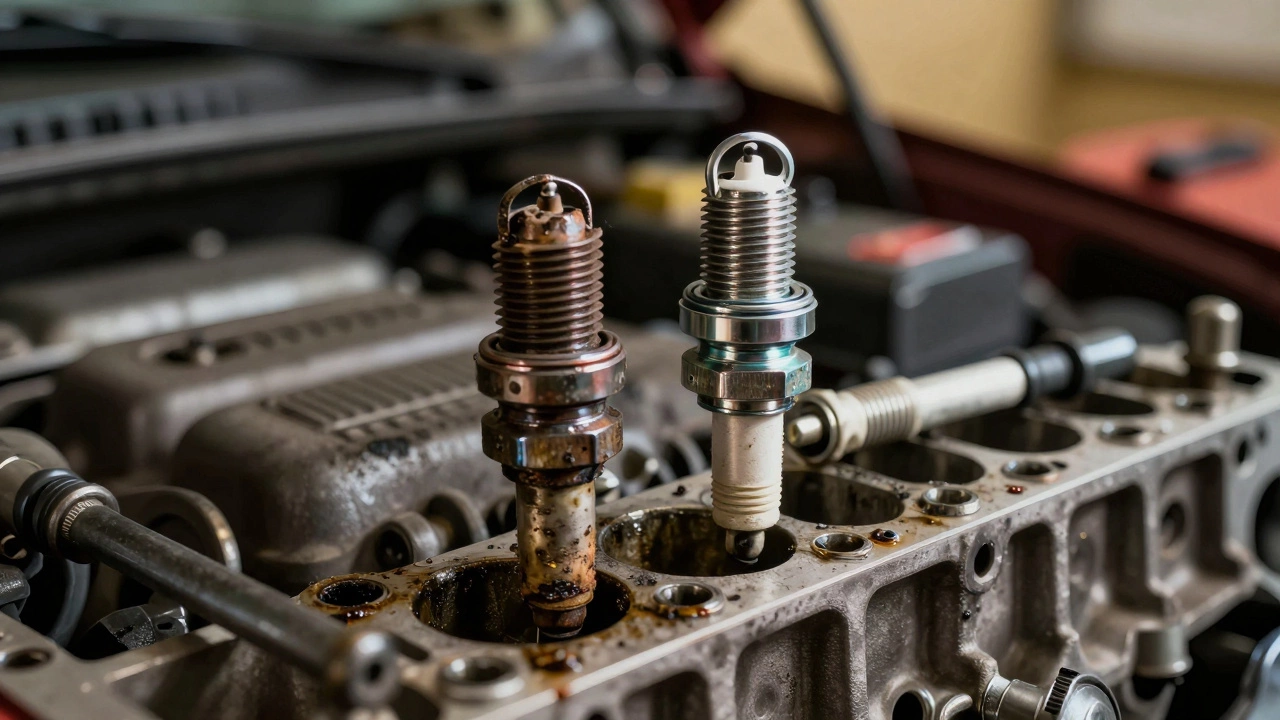
When spark plugs wear out-after 30,000 to 100,000 miles depending on type-they start to misfire. The spark gets weaker. It takes longer to jump the gap. Sometimes it doesn’t fire at all. That’s when you feel it: rough idle, hesitation on acceleration, worse fuel economy. Your engine isn’t making full power anymore. It’s running on fumes, literally.
Replacing worn spark plugs brings your engine back to factory performance. If your car was making 180 horsepower when new, and worn plugs cut that to 172, new ones bring it back to 180. That’s not a gain. That’s a correction.
High-performance spark plugs: do they help?
There’s a whole market for ‘performance’ spark plugs-iridium tips, platinum electrodes, fine-wire designs, racing brands like NGK V-Power or Denso Iridium TT. These aren’t scams. But they’re not power adders either.
What they do is improve reliability and longevity. Iridium plugs last longer. They resist fouling better in high-boost or high-temperature engines. They can fire more consistently under extreme conditions. That’s why they’re used in race cars and turbocharged street machines.
But here’s the catch: if your engine is stock, factory spark plugs are already tuned for optimal performance. Swapping in a hotter or colder plug, or one with a different gap, can actually hurt performance. Too hot? Detonation. Too cold? Carbon buildup. Wrong gap? Weak spark or misfires.
One study from the Society of Automotive Engineers (SAE) in 2022 tested 12 different spark plug types in a stock 2.0L turbo engine. The best-performing plug (a factory-replacement iridium) delivered 0.3% more torque than the original. The rest showed no measurable gain-or even slight losses. That’s less than half a horsepower in a 250-hp engine.
When spark plugs make a noticeable difference
There are two real situations where spark plugs make a clear difference:
- Your plugs are old or damaged. If you’ve never changed them and your car has over 80,000 miles, replacing them will feel like a tune-up. Acceleration tightens up. Idle smooths out. Fuel economy improves by 5-10%. That’s not horsepower-it’s efficiency restored.
- You’ve made other engine mods. If you’ve added a performance chip, upgraded the intake, or installed a turbo, your engine is running hotter and under more pressure. Factory plugs can’t keep up. Upgrading to a heat-resistant, properly gapped performance plug becomes necessary to prevent misfires and detonation. In this case, you’re not adding horsepower-you’re letting your other mods work as intended.
For example, a 2024 Subaru WRX owner who added a cat-back exhaust and a stage 1 tune noticed misfires around 5,000 RPM. Swapping the stock copper plugs for NGK Iridium IX with a 0.028-inch gap eliminated the issue. Power delivery became linear again. But the dyno showed no increase in peak horsepower. Just smoother, more consistent output.

What actually adds horsepower
If you want real gains, focus on what moves the needle:
- Intake and exhaust upgrades - Freeing up airflow lets the engine breathe better. A good cold air intake and performance exhaust can add 10-20 hp on most naturally aspirated engines.
- Tuning - A professional ECU tune adjusts fuel maps, ignition timing, and boost levels. This is the single biggest gain you can get on a modern car-often 20-40 hp without hardware changes.
- Forced induction - Adding a turbo or supercharger can double horsepower. That’s the real game-changer.
- Internal engine mods - Higher compression pistons, performance cams, ported heads. These require serious investment but deliver real results.
Spark plugs? They’re the match. You can have the best firewood in the world, but if the match is wet or broken, the fire won’t light. Replace the match, and the fire burns clean. But you’re not making the wood bigger-you’re just letting it burn right.
Choosing the right spark plug
Don’t buy based on looks or brand hype. Follow these rules:
- Use the manufacturer’s recommended plug. Check your owner’s manual. That’s the baseline.
- Only upgrade if you’ve modified the engine. If you’re running higher boost, more timing, or a leaner tune, then consider a colder heat range and a fine-wire iridium or platinum plug.
- Don’t change the gap unless you know why. Factory gap is set for a reason. Most aftermarket plugs come pre-gapped. Adjusting it without a gap tool and proper knowledge can cause more harm than good.
- Replace them on schedule. Copper plugs every 30,000 miles. Platinum every 60,000. Iridium every 90,000-100,000. Don’t wait for symptoms.
For a 2023 Honda Civic with 75,000 miles, sticking with the factory NGK LFR7A-11 (standard plug) is the smart move. Spending $80 on a ‘race’ plug won’t make it faster. But replacing worn plugs with the same type will make it feel like new again.

Myth vs. Reality
| Myth | Reality |
|---|---|
| More expensive spark plugs = more horsepower | They improve longevity and reliability, not peak power |
| Changing spark plugs boosts acceleration | Only if old plugs were causing misfires |
| Gap size doesn’t matter | Too wide = weak spark. Too narrow = incomplete burn. Factory spec is optimal |
| Performance plugs work on stock engines | Usually unnecessary. Can even cause issues if heat range is wrong |
| Spark plugs are the most important part of performance | They’re critical for reliability, but not a power source |
Bottom line
Spark plugs don’t add horsepower. They protect it. They ensure your engine runs the way it was designed to. If your plugs are worn, replacing them will make your car feel sharper, smoother, and more responsive. That’s not horsepower. That’s justice.
Want real power gains? Upgrade your air intake, get a tune, or add forced induction. Those move the needle. Spark plugs? They’re the silent partner. Do their job right, and your engine sings. Mess with them, and you’ll hear the misfire.
So don’t buy spark plugs hoping for more power. Buy them because your engine deserves to run clean. And when you do, you’ll notice something better than horsepower: peace of mind.
Can new spark plugs improve fuel economy?
Yes, if your old plugs were misfiring. Worn spark plugs cause incomplete combustion, which wastes fuel. Replacing them with properly gapped, factory-recommended plugs can improve fuel economy by 5% to 10%. That’s not a huge gain, but it’s real-especially if you’ve driven over 80,000 miles without a change.
Do iridium spark plugs last longer than copper ones?
Yes. Copper plugs typically last 30,000 to 40,000 miles. Platinum plugs last 60,000 to 80,000 miles. Iridium plugs can go 90,000 to 100,000 miles. That’s because iridium is harder and more heat-resistant. For most drivers, iridium is the best balance of longevity and reliability.
Can spark plugs cause engine damage?
Yes, if they’re the wrong type. Using a plug that’s too hot for your engine can cause pre-ignition or detonation, which can melt pistons or damage valves. Using a plug with the wrong gap can lead to misfires, which may damage the catalytic converter over time. Always match the plug to your vehicle’s specs.
Should I gap my spark plugs myself?
Only if you have a proper gap tool and know the correct specification. Most modern plugs come pre-gapped and shouldn’t be adjusted. Bending the ground electrode too much can weaken it or cause it to break off inside the cylinder-very expensive to fix. If you’re unsure, leave it alone.
Do spark plug wires make a difference?
On older cars with distributor-based ignition, yes-high-quality spark plug wires reduce resistance and interference. On modern cars with coil-on-plug systems, there are no wires. The coil sits directly on the plug. So unless you’re working on a car from the 1990s or earlier, spark plug wires aren’t relevant.
Next steps
If your car is running rough and you’re wondering if new spark plugs will fix it, check your maintenance records first. If it’s been over 60,000 miles since the last change, replace them with the manufacturer’s recommended type. No need to overpay.
If you’ve added performance mods, consult your tuner or the mod manufacturer’s recommendations. They’ll tell you if you need a different heat range or gap. Don’t guess.
If your car runs fine and you’re just curious about upgrades-skip it. Spend your money on an oil change or a good air filter. Those have more impact.
Spark plugs are simple. They’re not a performance secret. They’re a maintenance item. Treat them that way, and your engine will thank you for years.