 Feb, 20 2026
Driving on worn or damaged tires isn’t just a bad idea-it’s a gamble with your life. Every year in Canada, over 1,200 crashes are linked directly to tire failure. Most of them happen because drivers didn’t notice the warning signs until it was too late. You don’t need a mechanic to tell you your tires are done. There are clear, visible clues you can check yourself in under five minutes. Here’s how to know for sure when it’s time for new tires.
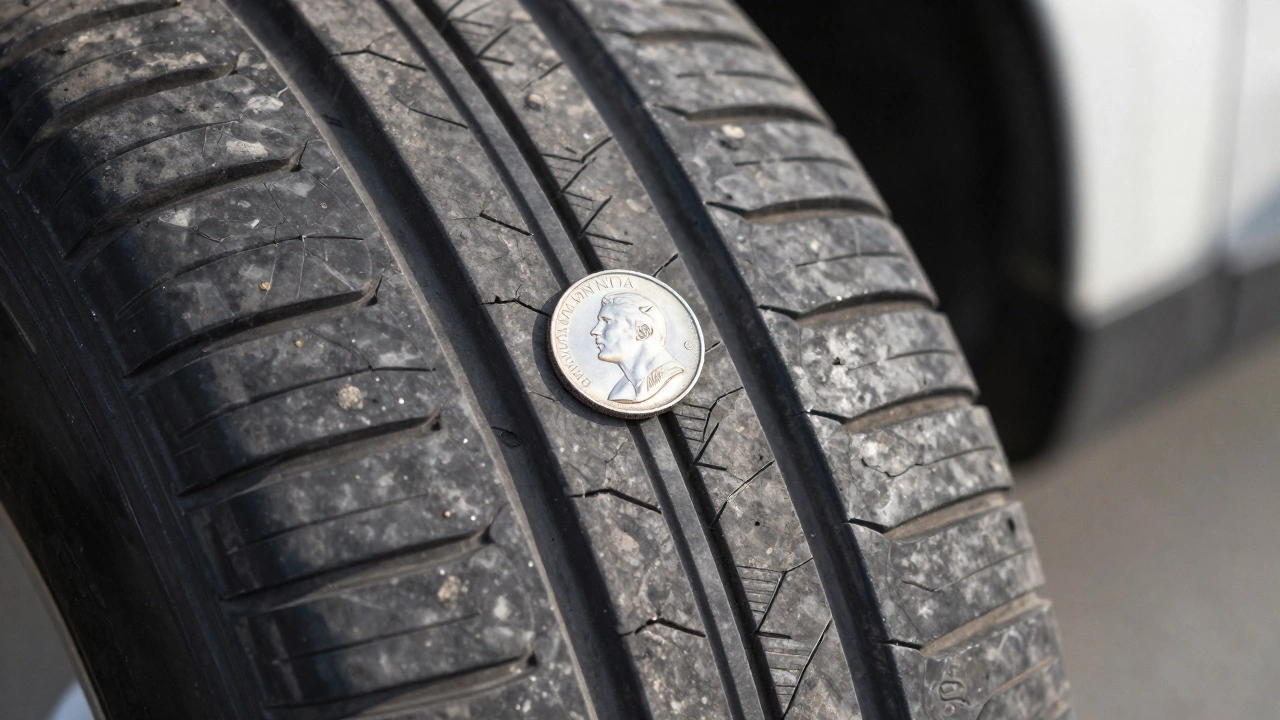
Check the tread depth with a loonie
The easiest way to check tire wear is using a loonie-Canada’s $1 coin. Put it into one of the main grooves on your tire, with the bear’s head facing down. If you can see the top of the bear’s head, your tread is below 2 mm, and you need new tires. The legal minimum in Ontario and most provinces is 1.6 mm, but safety experts agree 2 mm is the real cutoff. At 2 mm, your tire loses nearly half its ability to grip wet roads. By 1 mm, you’re basically hydroplaning every time it rains.
Check at least three spots across each tire: the inside, middle, and outside. Uneven wear? That’s not normal. It usually means your alignment is off, your suspension is worn, or you’re over/under-inflating. Don’t just replace the tire-find out why it wore unevenly.
Look for cracks and dry rot
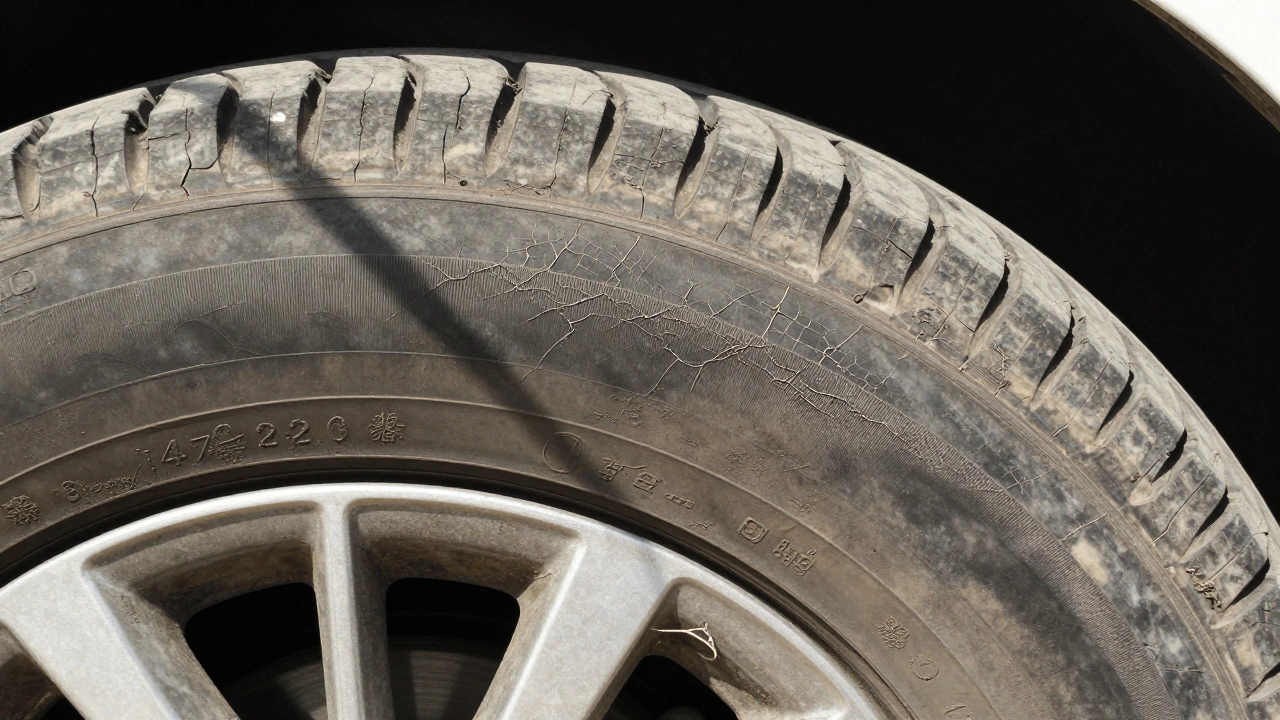
Tires don’t just wear out from driving. They age. Even if you drove only 5,000 km last year, your tires are still breaking down. Rubber gets brittle. Sunlight, heat, and ozone crack the surface. Look closely at the sidewalls-the sides of the tire, not the tread. If you see a pattern of small, spiderweb-like cracks, that’s dry rot. It doesn’t show up in tread depth tests. But it can cause a blowout at any speed.
Most tires last 6 to 8 years, no matter how much you drive. Check the DOT code on the sidewall. It’s a 4-digit number at the end of a long string. The last two digits tell you the year it was made. The first two? The week. So if you see “2220,” that tire was made in the 22nd week of 2020. If it’s older than 6 years, start planning for replacement. Don’t wait for cracks to get worse.
Feel for bulges, bubbles, or flat spots
If you hit a pothole hard or ran over a curb, your tire’s internal structure might be damaged. You won’t always feel it while driving. But you’ll see it. Look for bulges or bubbles on the sidewall. These mean the inner layers have separated. That’s a ticking time bomb. One sharp turn or high-speed bump, and it blows.
Flat spots? Those happen if you parked with the tires deflated for weeks, or if you slammed on the brakes hard enough to lock the wheels. They cause vibrations you’ll feel in the steering wheel or seat. If you notice a rhythmic thumping at highway speeds, stop and inspect the tires. A flat spot can’t be fixed. Only replacement works.
Listen for unusual noises
Your tires talk. You just have to listen. A constant humming or whining sound that gets louder as you speed up? That’s often tread wear patterns from uneven rotation or worn suspension. A clicking noise when turning? Could be a damaged tread edge or internal belt separation. A loud thump every few seconds? That’s a flat spot or a broken steel belt.
These sounds aren’t normal. They’re your tire screaming for help. Ignore them, and you risk losing control. If you hear something new, pull over at the next safe spot. Get out, walk around the car, and run your hand over the tread and sidewalls. If something feels off, it probably is.
Check the tire pressure warning light
Modern cars have TPMS-Tire Pressure Monitoring Systems. If that light comes on, it’s not just a reminder to check pressure. It’s often the first sign your tire is losing air because of a slow leak, a puncture, or internal damage. Don’t just inflate and forget. A tire that keeps losing pressure is failing. It might have a nail you didn’t see, or a cracked valve stem. Or worse-it’s already structurally compromised.
Even if the light goes off after you inflate, keep monitoring. A tire that needs refilling every two weeks isn’t healthy. It’s on borrowed time. Replace it before it fails on a highway.
When in doubt, get a professional inspection
You can do a lot yourself. But some damage hides. A small cut on the sidewall might look harmless. But if it’s deep enough to reach the inner layers, it’s a risk. A crack that looks dry might be spreading under the surface. You can’t see that without removing the tire from the rim.
Every 12,000 km or once a year, take your car to a trusted shop for a tire inspection. They’ll check internal wear, balance, and alignment. Most places do it for free. Use that service. It’s cheaper than a tow truck, a new wheel, or a hospital bill.
Replacing tires isn’t about saving money. It’s about staying alive. A set of four good tires costs less than one emergency repair. And far less than the cost of an accident you could have avoided.
Don’t wait for the warning light
Most drivers wait until the tread looks bald or the light flashes. That’s too late. By then, your stopping distance on wet roads has doubled. Your steering response is sluggish. Your risk of a blowout has jumped 300%.
Be proactive. Check your tires every time you fill up. Use the loonie test. Look for cracks. Listen for noise. Know the DOT date. You don’t need a degree in automotive engineering. You just need to look.
Your tires are the only thing between you and the road. If they’re failing, nothing else on your car matters.
How often should I replace my tires?
Most tires last between 40,000 and 80,000 kilometers, but age matters more than mileage. Even if you drive little, replace tires after 6 years. If you live in a place with hot summers and snowy winters-like Hamilton-your tires wear faster. Check the DOT code on the sidewall. If it’s older than 6 years, start shopping for replacements.
Can I drive on a tire with a nail in it?
Maybe, but not for long. If the nail is in the tread and the tire isn’t losing air, you can drive slowly to a shop. But don’t drive on it for days. The nail can work deeper, or the puncture can expand. A professional can patch it if it’s in the center of the tread. Sidewall or shoulder punctures? No repair. Replace the tire.
Is it okay to replace just one tire?
Only if the other three are nearly new. Replacing one tire can throw off your car’s balance, especially if it’s all-wheel drive. The difference in tread depth can damage your differential. Best practice: replace tires in pairs, or better yet, all four. If you must replace one, match it exactly-same brand, model, size, and tread pattern.
Do I need winter tires if my all-season tires look fine?
Yes, if you drive in winter conditions. All-season tires harden below 7°C. They lose grip on snow and ice. Winter tires stay soft and flexible, with deeper tread and special rubber compounds. Even if your all-seasons have plenty of tread, they’re not safe in snow. In Ontario, many insurance companies offer discounts for winter tires. It’s not just smart-it’s cheaper.
What’s the best way to extend tire life?
Check pressure monthly-especially before long trips. Under-inflated tires wear faster and get hotter. Rotate them every 10,000 km. Get alignment checked every 2 years or after hitting a pothole. Avoid speeding over curbs and potholes. And don’t ignore vibrations. They’re early warnings.