 Dec, 1 2025
Radiator Failure Diagnostic Checklist
Check off the signs you're experiencing to determine if your radiator might be failing.
Results
Your car’s radiator doesn’t make noise when it’s failing. It doesn’t flash a warning light until it’s too late. By the time your temperature gauge hits red, you’ve already damaged your engine. If you’ve noticed your car running hotter than usual, or you’re refilling coolant every few weeks, your radiator might be on its last legs.
Overheating is the biggest red flag
If your engine temperature climbs into the red zone - especially during normal driving or mild weather - your radiator is likely not doing its job. This isn’t just about a faulty thermostat or a loose fan belt. A failing radiator can’t transfer heat away from the engine fast enough. In Hamilton winters, where you’re idling in traffic for 20 minutes at a time, a weak radiator will show up fast. You’ll feel the cabin heat drop, the engine sounds strained, and the temperature needle creeps up even when you’re not pushing the car.
Real-world example: A 2018 Honda Civic came into a shop last January with coolant loss every 3 days. The owner thought it was a leaky hose. Turns out, the radiator core had internal corrosion blocking coolant flow. The car ran fine on short trips, but stalled after 15 minutes on the highway. That’s classic radiator failure - it works until it’s under load.
Coolant leaks you can’t see
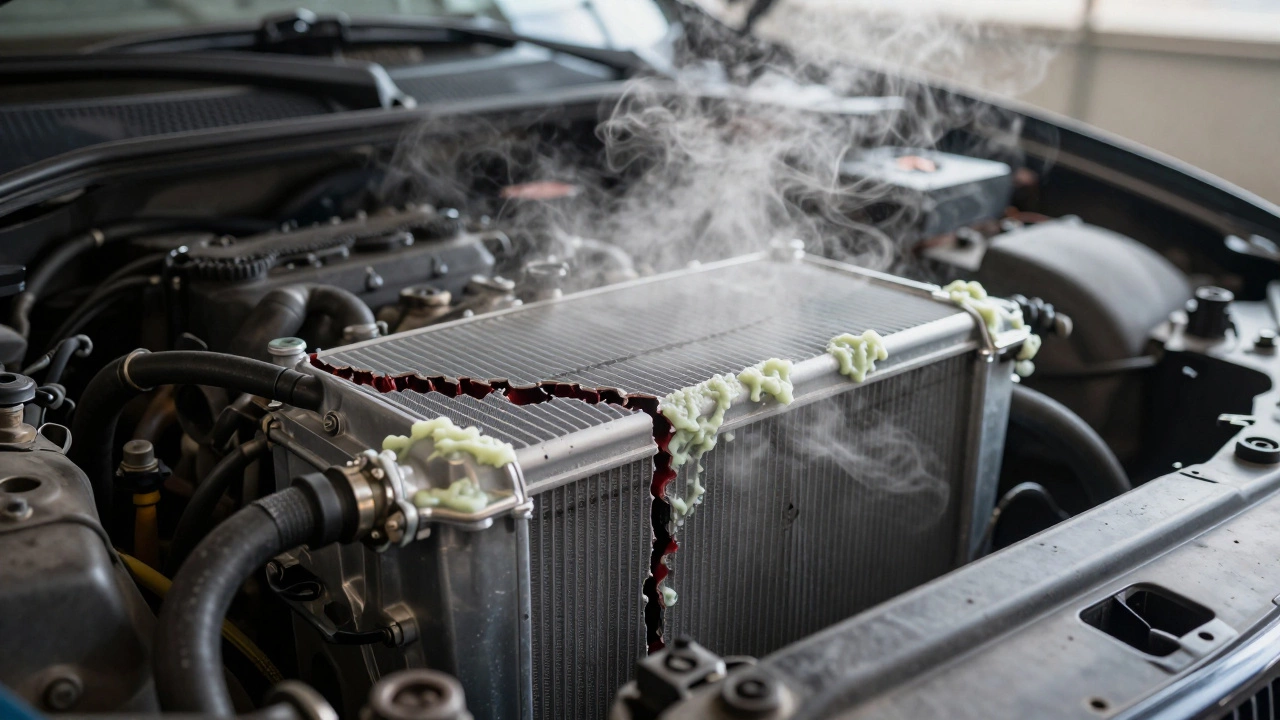
Most people check for puddles under the car. That’s smart, but it’s not enough. Radiator leaks aren’t always obvious. A small crack in the plastic end tank, a pinhole in the aluminum core, or a failing seal at the hose connection won’t always drip. Instead, coolant gets pushed out as steam when the system heats up. You’ll smell sweet, syrupy steam coming from under the hood - especially after driving. That smell? That’s antifreeze burning off. It’s not normal. And if you’re topping off coolant more than once a month, you’ve got a problem.
Check the coolant level when the engine is cold. If it’s consistently low, even with no visible puddles, trace the hoses back to the radiator. Look for crusty, white-green residue around the filler neck, hose clamps, or the radiator cap. That’s dried coolant. It’s a silent leak.
Discolored or sludgy coolant
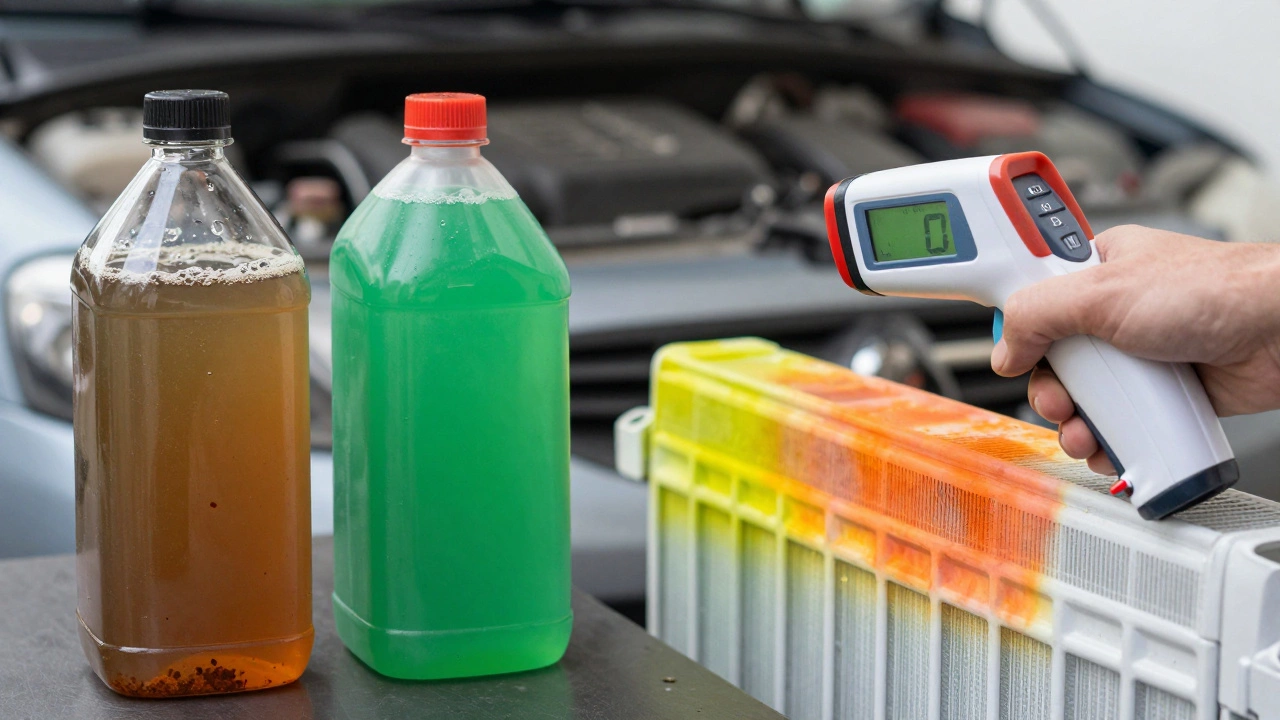
Healthy coolant is bright green, red, or orange - depending on the type. It should look clean, almost like water. If it’s brown, murky, or has floating flakes, your radiator is corroding from the inside. Rust and debris build up in the core, blocking coolant passages. This is common in older cars that haven’t had coolant changed in 5+ years. In cold climates like Hamilton, rust forms faster because of moisture and temperature swings.
Take a sample. Pour a little into a clear bottle. Let it sit. If you see sediment settling at the bottom, or the fluid looks like weak tea, your radiator is clogging. A clogged radiator doesn’t just overheat - it overheats unevenly. That’s why your heater blows hot one minute and cold the next.
Visible damage on the radiator itself
Pop the hood and look at the radiator. Not just the top - the whole thing. Look for dents, cracks, or bent fins on the front surface. Even a small dent from a rock or road debris can crush internal tubes. The radiator is made of thin aluminum and plastic. It doesn’t take much to break it.
Also check the radiator cap. A worn or cracked cap won’t hold pressure. That’s critical. Modern radiators run at 15-20 psi. If the cap fails, coolant boils at a lower temperature. You’ll get overheating even if the radiator itself is fine. Replace the cap every 3-5 years - it’s cheap and often forgotten.

Engine oil mixed with coolant
This is serious. If you open your oil dipstick and see a milky, frothy substance - like chocolate milk - you’ve got a blown head gasket or a cracked engine block. But sometimes, it’s the radiator. A cracked internal passage can let coolant seep into the oil system. This is rare, but it happens. If you see this, don’t drive the car. Mixing coolant and oil destroys bearings and can seize your engine in minutes.
Check the temperature difference across the radiator
This is a trick mechanics use. After the engine has warmed up, carefully feel the top and bottom radiator hoses (use gloves - they’re hot). The top hose should be very hot, near engine temperature. The bottom hose should be warm, but not scalding. If the bottom hose is cold, coolant isn’t flowing. That means the radiator is blocked.
Another test: Use an infrared thermometer if you have one. Point it at the radiator fins. The top half should be hot, the bottom half cooler. If the whole thing is uneven - patches of cold spots - you’ve got internal blockage. A healthy radiator has even heat distribution.
What happens if you ignore it
Driving with a bad radiator doesn’t just risk overheating. It destroys your engine. Aluminum heads warp. Head gaskets blow. Pistons seize. A $300 radiator repair turns into a $4,000 engine rebuild. In 2024, the average cost to replace a head gasket on a mid-size sedan was $2,800 in Ontario. That’s not a mistake - that’s preventable.
One mechanic in Hamilton told me he sees three engine replacements every winter from drivers who ignored a slow coolant leak. They thought, “It’s just a little low.” That little low became a cracked block.
What to do next
If you’ve noticed any of these signs - overheating, coolant loss, sludge, strange smells, or uneven hose temps - don’t wait. Take your car to a trusted shop and ask for a pressure test. They’ll pressurize the cooling system and check for leaks. It takes 15 minutes. Costs $50-$80. Far cheaper than replacing your engine.
If your radiator is old (10+ years) and you’ve had repeated cooling issues, replace it. Don’t try to patch it. Modern radiators are cheap - $200-$400 for most models. Labor’s another $150-$250. You’ll get 10+ more years of reliable use.
And while you’re at it, flush the entire cooling system. Old coolant turns acidic. It eats away at metal parts. Even if your radiator is fine, dirty coolant will kill the next one.
Prevention is simple
Change your coolant every 5 years or 100,000 km - whichever comes first. Use the right type. Don’t mix colors. Don’t top off with water unless it’s an emergency. And check the level every time you fill up. Five seconds. That’s all it takes to catch a problem before it costs you thousands.
Can a bad radiator cause my car to stall?
Yes. When a radiator fails, the engine overheats. Modern cars have safety systems that shut down the engine to prevent damage. If your car stalls after running for 10-15 minutes, especially in traffic or on the highway, it’s likely overheating due to a blocked or leaking radiator.
Is it safe to drive with a small radiator leak?
No. Even a small leak can lead to complete coolant loss within a few hours. Without enough coolant, your engine will overheat and suffer permanent damage. If you notice a leak - even a drip once a week - get it checked immediately. It’s not worth the risk.
How long does a radiator typically last?
Most radiators last 8 to 12 years, or 100,000 to 150,000 km. But in places with harsh winters and road salt - like Hamilton - life expectancy drops to 6-8 years. Corrosion from salt and moisture eats away at aluminum and plastic parts faster than in drier climates.
Can a radiator be repaired instead of replaced?
Sometimes, but rarely. Small external leaks in hoses or tanks can be patched. But internal corrosion, clogged tubes, or cracked cores can’t be fixed reliably. Most shops recommend replacement because a repaired radiator often fails again within months. It’s cheaper to replace it right than to pay for a second repair.
Why does my heater blow cold air when the engine overheats?
Your heater core uses hot coolant from the engine to warm the cabin. If the radiator is clogged or leaking, coolant doesn’t circulate properly. That means not enough hot fluid reaches the heater core. So even though the engine is hot, the air from your vents stays cold. It’s a sign the cooling system isn’t working as a whole.
Does using the wrong coolant damage the radiator?
Yes. Mixing different types - like green and orange - can cause chemical reactions that form sludge. That sludge clogs the radiator’s tiny passages. Always use the coolant type specified in your owner’s manual. If you’re unsure, check the cap or ask a mechanic. Using the wrong fluid can destroy your radiator in as little as a year.
Final tip: Keep a spare bottle of coolant in your trunk
Especially in winter. If you’re stranded with low coolant, adding a little can buy you time to get to a shop. Don’t wait until the engine is boiling. Stop, turn off the car, and wait 20 minutes before opening the cap. Then add coolant slowly. It won’t fix the problem - but it might keep your engine alive until you can get help.