 Jun, 23 2026
Spark Plug Replacement Calculator
Are you experiencing any of these symptoms?
Financial Impact Analysis
- Replacement Cost:
- Fuel Waste (if worn): /year
- Risk of Coil Damage:
Recommendation Details
Your car starts fine. It drives smoothly. There are no warning lights on the dashboard. So why would you spend money and time changing spark plugs that seem to be working perfectly?
This is a classic debate in every garage and driveway across Canada. On one side, mechanics argue for preventive maintenance. On the other, drivers want to squeeze every last mile out of a part before replacing it. The truth isn't black and white. It depends entirely on what kind of spark plugs your vehicle uses and how much you value long-term reliability versus short-term savings.
If you ignore them until they fail, you might save $100 today but risk a $500 tow bill tomorrow. If you replace them too early, you're just burning cash for peace of mind. Let's break down exactly when you should swap them out, even if your car feels like new.
The Hidden Cost of "Good Enough" Performance
We often think of spark plugs as binary components: either they fire, or they don't. In reality, their performance degrades gradually. A worn plug doesn't usually die instantly; it gets lazy. The gap between the electrodes widens slightly over thousands of miles. This forces your ignition coil to work harder to jump that gap with electricity.
When the coil works harder, it generates more heat. Excessive heat can damage the coil itself. Replacing four spark plugs costs maybe $80 to $150 in parts and labor. Replacing four ignition coils because old plugs overheated them can cost $400 to $800. That’s the hidden trap. You aren’t just buying new plugs; you’re protecting expensive surrounding components.
Think of it like brake pads. You don’t wait until you hear metal grinding against metal to change them. You change them when the wear indicator suggests they’re nearing the end of their life, to protect the rotors. Spark plugs are similar. They protect the ignition system and ensure clean combustion.
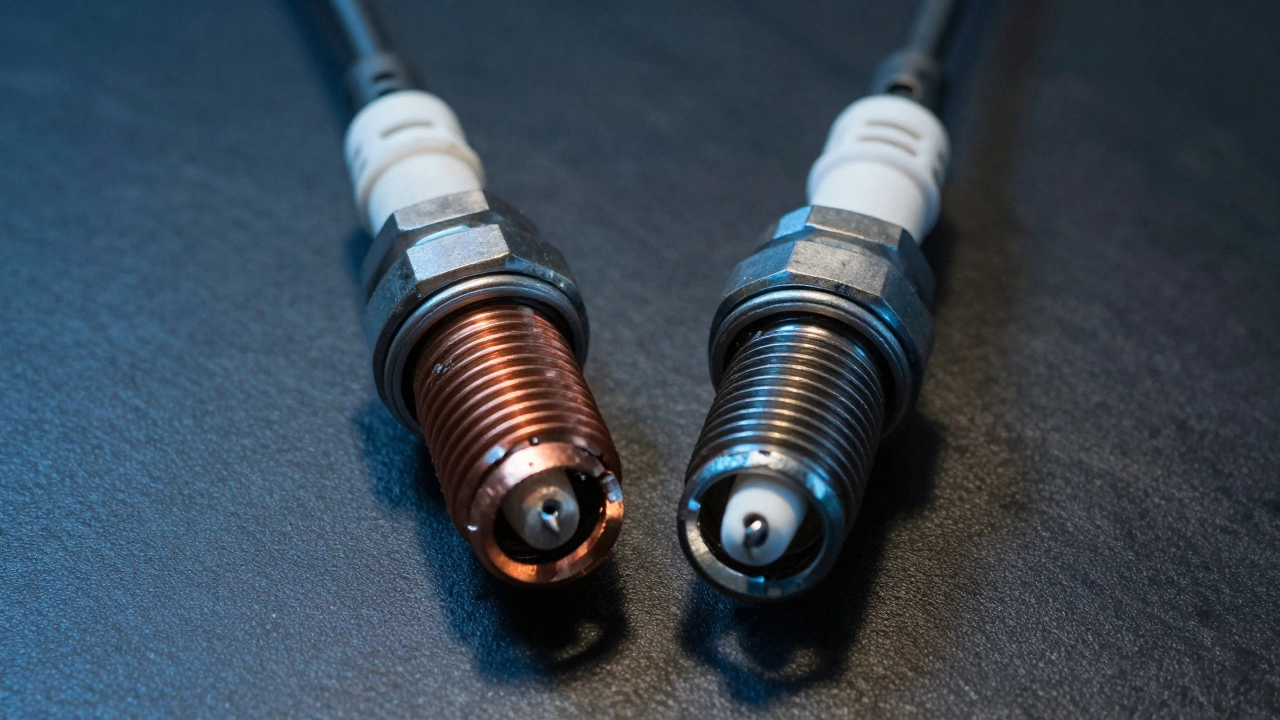
Material Matters: Copper vs. Iridium
Not all spark plugs are created equal. The material used in the center electrode determines how long they last and how well they perform. This is the most critical factor in deciding whether to change them preemptively.
| Material Type | Typical Lifespan (km) | Performance Profile | Replace Preventively? |
|---|---|---|---|
| Copper Core | 30,000 - 48,000 km | Excellent conductivity, wears quickly | Yes, strictly by mileage |
| Platinum | 60,000 - 96,000 km | Durable, consistent spark | Recommended at interval |
| Iridium | 120,000 - 160,000 km | Superior longevity, precise firing | No, unless damaged |
| Double Platinum | 96,000 - 120,000 km | Great for waste-spark systems | Recommended at interval |
If you drive an older vehicle or a high-performance muscle car from the 2000s, you likely have copper-core plugs. These wear out fast. The tip erodes, the gap widens, and efficiency drops. For these, yes, you should change them on schedule even if the car runs fine. The degradation happens silently, sapping horsepower and increasing fuel consumption by 1-3%.
However, if you drive a modern sedan, SUV, or hybrid manufactured after 2015, you probably have iridium or platinum plugs. These are engineered to last the life of the engine in many cases. An iridium plug can easily go 160,000 kilometers without significant loss in performance. Changing these at 80,000 km because a mechanic suggested it is usually a waste of money. They are still firing efficiently.
Signs Your Plugs Are Dying (Even If You Don't Feel It)
You mentioned "nothing is wrong." But are you sure? Drivers often adapt to gradual changes without realizing it. Your brain normalizes a slight hesitation or a tiny increase in gas bills. Here are subtle signs that your plugs are past their prime:
- Increased Fuel Consumption: Check your average liters per 100 km. If it has crept up by 0.5 L/100km or more without a change in driving habits, misfiring plugs could be the culprit. Incomplete combustion means unburned fuel goes straight out the tailpipe.
- Hard Starts in Cold Weather: Hamilton winters are brutal. If your car takes an extra second to crank in January but was fine last year, weak sparks struggle to ignite the cold, dense air-fuel mixture.
- Rough Idle: Sit at a red light. Does the steering wheel vibrate slightly? Does the RPM gauge fluctuate up and down by a tiny amount? This is often a sign of minor misfires caused by aging plugs.
- Poor Acceleration Response: When you step on the gas, does the car hesitate for a split second before surging forward? This "bogging down" indicates the engine control unit is struggling to maintain optimal timing due to inconsistent spark energy.
If you notice any of these, don't wait. Replace them immediately. If you notice none of these, look at your odometer.
The Manufacturer's Schedule: Law or Suggestion?
Your owner's manual contains the maintenance schedule set by the engineers who built your car. For most modern vehicles, this schedule specifies an interval for spark plug replacement. Is this mandatory?
Technically, no. Your car won't lock you out if you miss the appointment. However, ignoring the manufacturer's recommended interval can void certain aspects of your warranty. More importantly, these intervals are calculated based on extensive testing. They represent the point where the majority of plugs begin to show measurable decline in efficiency.
For example, Toyota often recommends replacing iridium plugs at 160,000 km. Honda might suggest 100,000 km for platinum plugs. BMW frequently requires checks at 60,000 km for some models. These numbers aren't arbitrary. They account for heat cycles, vibration, and chemical erosion inside the cylinder head.
If you are close to this number-say, within 5,000 to 10,000 km-it makes sense to change them. Why? Because you're already planning a service visit for oil or brakes. Adding spark plugs to that job minimizes labor costs since the mechanic is already accessing the engine bay. Doing it separately later doubles the labor charge.
When to Skip the Replacement
There are scenarios where changing spark plugs is pure financial leakage. Avoid them:
- New Car with Low Mileage: If you bought a two-year-old lease return with 40,000 km and it has factory iridium plugs, do not change them. They have another 100,000+ km of life left. A dealer suggesting otherwise is upselling you.
- Selling the Car Soon: If you plan to sell your vehicle in the next three months, changing spark plugs offers zero return on investment. Buyers rarely check plug condition, and it won't significantly boost resale value.
- Using Cheap Aftermarket Parts: Never replace OEM iridium plugs with cheap copper ones to "save money." You'll degrade performance and shorten the lifespan drastically. Stick to the specified type.

The DIY Factor: Labor Costs in 2026
In 2026, automotive labor rates in Ontario continue to rise. A simple four-cylinder engine might cost $150-$200 in labor alone to change plugs. Some modern engines, particularly turbocharged direct-injection models, require removing intake manifolds or intercoolers to access the rear bank of plugs. This can push labor costs to $400 or more.
If you are handy with tools, doing this yourself saves significant money. All you need is a socket wrench, a spark plug socket, a torque wrench, and the correct gap tool. YouTube tutorials make this accessible for most common cars. However, if your engine is complex (like a V8 with tight packaging or a transverse inline-6 with limited clearance), professional help prevents stripped threads or dropped plugs into cylinders-a nightmare scenario.
Consider the total cost of ownership. If labor is $200 and plugs are $60, the total is $260. If you delay replacement by 20,000 km and suffer a 2% drop in fuel economy, and you drive 20,000 km a year using gasoline at $1.50/L, you might lose $300-$400 in fuel costs. In this case, preventive replacement pays for itself through improved efficiency.
Environmental Impact and Emissions
Clean-running engines emit fewer pollutants. Worn spark plugs cause incomplete combustion, leading to higher levels of hydrocarbons (HC) and carbon monoxide (CO) in exhaust gases. In cities like Toronto or Vancouver, where emissions testing is periodic, failing a smog check due to rich running conditions can be costly and inconvenient.
Fresh spark plugs ensure the catalytic converter operates at peak efficiency. A clogged or overheated catalytic converter due to raw fuel passing through it can cost thousands to replace. Maintaining proper ignition health is thus an environmental and economic choice.
Final Verdict: To Change or Not to Change?
Here is your decision tree:
- Check the Odometer: Are you near the manufacturer's recommended interval? Yes → Change them. No → Keep them.
- Identify the Material: Copper? Change every 50k km. Platinum? Every 80-100k km. Iridium? Only at 150k+ km or if symptoms appear.
- Assess Symptoms: Rough idle, hard starts, poor MPG? Change them immediately regardless of mileage.
- Plan Ahead: Due for other major service? Add plugs to the list to save on labor.
If your car has iridium plugs, is under 100,000 km, and runs smoothly, leave them alone. Save your money. If you have copper plugs or are approaching the service interval, replace them now. It’s cheaper than fixing the damage they cause when they finally fail.
Can bad spark plugs damage my engine?
Yes. Severe misfires caused by failed spark plugs allow unburned fuel to enter the exhaust system. This can overheat and destroy the catalytic converter, which is extremely expensive to replace. Additionally, prolonged misfires can wash away lubricating oil from cylinder walls, causing premature piston ring wear.
How much does it cost to change spark plugs?
Parts typically range from $10 to $40 per plug depending on material (copper vs. iridium). Labor varies widely: $100-$200 for easy-access engines, and $300-$600 for complex designs requiring manifold removal. Total costs usually fall between $150 and $500 for a complete job at a shop.
Will new spark plugs improve gas mileage?
If your current plugs are worn, yes. Fresh plugs restore optimal combustion efficiency, which can improve fuel economy by 1% to 3%. While this seems small, over 20,000 km, it can save tens of dollars in fuel. However, if your plugs are still in good condition, new ones will provide negligible benefit.
Can I replace spark plugs myself?
For most standard four-cylinder and V6 engines, yes. It requires basic hand tools and careful attention to torque specifications. However, if your engine has limited access or requires removing major components, it is safer and often more cost-effective to hire a professional to avoid damaging threads or dropping debris into the engine.
What happens if I use the wrong spark plugs?
Using plugs with incorrect heat ranges, thread sizes, or resistance values can cause pre-ignition (knocking), fouling, or misfires. This leads to poor performance, increased emissions, and potential engine damage. Always consult your owner's manual or a reputable parts catalog to match the exact specification required by your vehicle.