 Nov, 3 2026
Radiator Health Diagnostic Tool
Select the symptoms you are currently experiencing with your vehicle to receive an instant risk assessment and recommended next steps.
Select symptoms to see your diagnostic report.
You’re driving down the highway, and suddenly the temperature gauge starts creeping toward the red zone. Or maybe you notice a puddle of greenish fluid under your parked car that wasn’t there yesterday. These aren’t just minor annoyances; they are your car screaming for help. The radiator is the heart of your vehicle's cooling system, responsible for dissipating heat from the engine coolant to keep everything running at optimal temperatures. When it fails, things go south fast-literally.
Ignoring the early warning signs can turn a $150 fix into a $2,000 engine replacement. But how do you know if your radiator is actually failing versus just needing a top-up on coolant? Let’s break down the specific symptoms, why they happen, and what you should do before your engine seizes up.
The Most Obvious Sign: Engine Overheating
If there is one symptom that screams "radiator trouble," it’s an overheating engine. The cooling system relies on the radiator to release heat from the hot coolant circulating through the engine block. If the radiator’s fins are clogged with debris or its internal passages are corroded, heat gets trapped.
Watch your dashboard gauge closely. In most modern cars, normal operating temperature sits between 195°F and 220°F (90°C-104°C). If you see the needle climbing past 230°F while idling in traffic or climbing a hill, stop immediately. Continuing to drive an overheated car can warp the cylinder head or blow a head gasket within minutes.
- Check the heater: Paradoxically, if your cabin heater blows cold air while the engine is hot, coolant isn’t circulating properly. This often points to a blocked radiator core.
- Steam from the hood: Seeing steam billow from under the hood means the coolant has boiled over. Turn off the AC, turn on the heater to pull heat away from the engine, and pull over safely.
Coolant Leaks and Puddles
A healthy coolant reservoir stays full. If you find yourself topping it off every week, something is leaking. Coolant comes in various colors-green, orange, pink, or blue-depending on the brand and formulation, but it always leaves a distinct, sweet-smelling residue.
Radiators develop leaks for two main reasons: physical damage or corrosion. Road debris like rocks can crack the plastic tanks or puncture the aluminum core. More commonly, age causes corrosion inside the metal tubes. Small pinhole leaks might only show up as dampness around the seams, while larger cracks will drip steadily onto your driveway.
| Leak Location | Likely Cause | Radiator Connection |
|---|---|---|
| Center of front bumper | Cracked radiator tank or core | Direct radiator failure |
| Near water pump | Water pump seal failure | Indirect; check radiator pressure cap too |
| Under engine block | Head gasket leak | Systemic issue; radiator may be fine |
| Hose connections | Worn clamps or brittle hoses | Peripheral; replace hoses first |
Discolored or Contaminated Coolant
Pull out your dipstick or look at the overflow tank. Fresh coolant looks vibrant and clear. Old or bad coolant looks muddy, oily, or rusty. If your coolant resembles chocolate milk, oil has mixed with it. This usually indicates a blown head gasket, not necessarily a bad radiator, but the radiator will suffer consequences quickly because oil coats the internal fins and stops heat transfer.
Rusty coolant, on the other hand, suggests internal corrosion. The anti-corrosion additives in coolant have depleted, allowing rust to form inside the radiator and engine block. Rust particles can clog the narrow tubes of the radiator, restricting flow and causing localized hot spots.
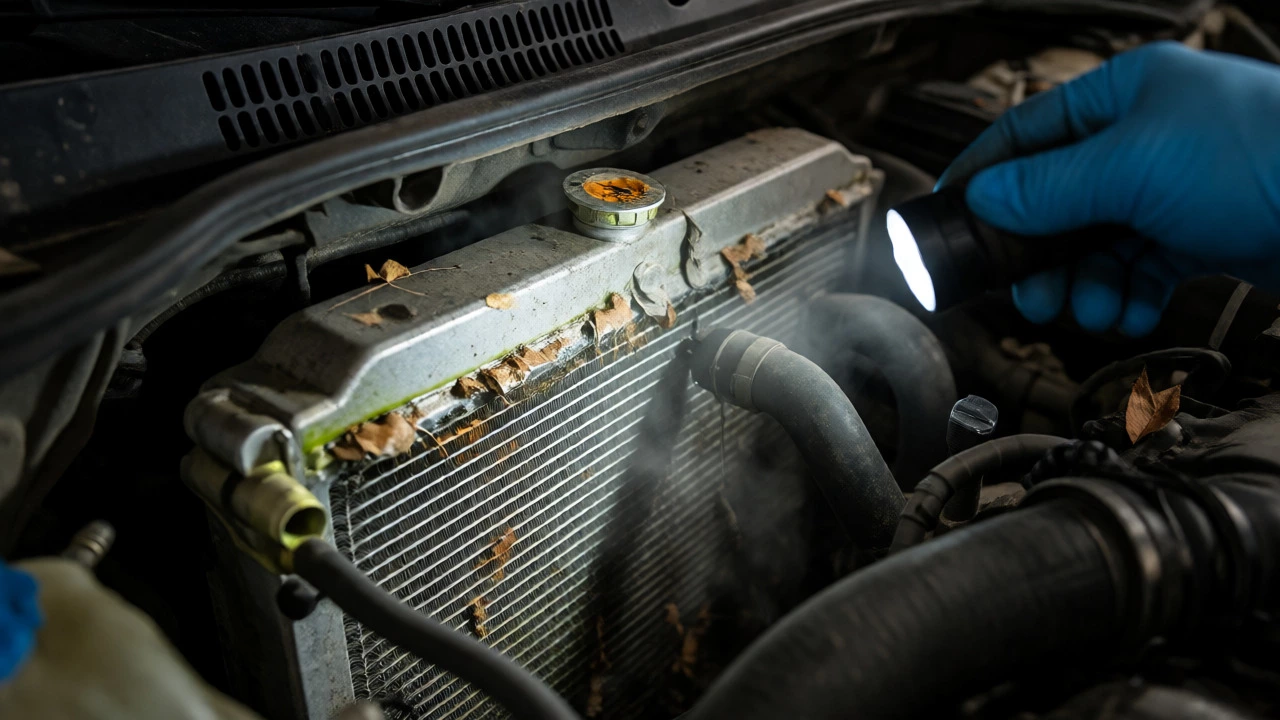
Bent or Damaged Fins
Take a flashlight and look through the front grille. The radiator is covered in thin metal fins designed to maximize surface area for heat dissipation. If these fins are bent, crushed, or clogged with bugs, dirt, and leaves, air cannot flow freely through them.
This is especially common after minor fender benders or off-road driving. While bent fins don’t cause immediate leaks, they reduce efficiency. Your fan has to work harder, and the engine runs hotter than it should. You can carefully straighten minor bends with a fin comb, but extensive damage often requires replacement.
Strange Noises and Smells
Your ears and nose can detect problems before your eyes do. A bad radiator might produce hissing sounds from escaping steam or gurgling noises from air pockets trapped in the system due to low coolant levels. Air pockets prevent proper circulation, leading to erratic temperature readings.
Additionally, a burning smell when the engine is hot can indicate coolant dripping onto hot exhaust components. This isn’t always a radiator issue-it could be a hose-but it’s part of the same ecosystem. If the smell persists after checking hoses, inspect the radiator seams.

How to Confirm It’s the Radiator
Before you buy a new part, rule out the usual suspects. Many drivers blame the radiator when the culprit is actually the thermostat, water pump, or cooling fan.
- Test the Thermostat: If the engine heats up slowly and then stabilizes, the thermostat is likely stuck closed. If it heats up instantly, the thermostat might be stuck open (less common for overheating).
- Check the Fan: With the engine warm and AC off, the electric fan should kick on. If it doesn’t, a faulty relay or motor is the problem, not the radiator itself.
- Pressure Test: This is the gold standard. Auto parts stores often lend out coolant pressure testers for free. Pump the system to the specified PSI (usually 15-18 psi). If the pressure drops rapidly without visible external leaks, the radiator or head gasket is compromised.
Repair vs. Replace: Making the Call
Should you patch it or swap it? For older vehicles with plastic-tank radiators, replacement is almost always cheaper and more reliable than repair. Plastic tanks become brittle over time, and soldering aluminum cores is difficult and often temporary.
New aftermarket radiators typically cost between $60 and $150. Labor adds another $100-$200. Attempting a DIY fix with epoxy or stop-leak products might save money short-term, but these solutions can clog smaller passages like the heater core, creating new headaches later.
Frequently Asked Questions
Can I drive with a bad radiator?
You should avoid driving long distances. Short trips to a nearby mechanic might be okay if the leak is minor and you monitor the temperature gauge constantly. However, driving with a cracked radiator risks sudden coolant loss, which can destroy your engine in minutes. If the temperature gauge rises above normal, pull over immediately.
How much does it cost to fix a leaking radiator?
A simple patch or sealant kit costs under $20, but this is a temporary fix. Professional radiator replacement typically ranges from $200 to $500 total, including parts and labor. High-performance or luxury vehicles with complex cooling systems can cost significantly more, sometimes exceeding $800.
Is a radiator flush enough to fix overheating?
Sometimes. If the overheating is caused by sediment buildup or old coolant losing its anti-corrosion properties, a flush can restore flow and heat transfer. However, if the radiator has physical damage, bent fins, or internal corrosion holes, flushing won’t solve the problem. Always diagnose the root cause first.
Why is my radiator leaking but the engine isn't overheating yet?
Your cooling system has a margin of safety. A small leak reduces coolant volume, but the remaining fluid might still be enough to handle current heat loads. As soon as demand increases-like towing a trailer, climbing hills, or stopping in heavy traffic-the reduced capacity will fail, leading to rapid overheating.
How long do car radiators last?
Most modern radiators are designed to last between 8 to 10 years or 100,000 miles. Factors like climate, road conditions, and maintenance habits play huge roles. Using distilled water instead of tap water during coolant changes can extend life by preventing mineral deposits.