 Dec, 2 2025
Fuel Savings Calculator
How Bad Spark Plugs Affect Your Wallet
Calculate your potential savings by replacing worn spark plugs. Bad plugs can reduce fuel economy by 15-30%, costing you hundreds extra each year.
Your Savings
Replacing your spark plugs could save you up to 30% on fuel costs. Bad spark plugs cause misfires that burn extra fuel without providing power.
Hamilton drivers with winter fuel costs often see $40-$70 extra monthly due to bad plugs.
Driving with bad spark plugs isn’t just a minor inconvenience-it’s like running your car on half its fuel. You might not notice right away, but over time, the damage adds up. Your engine stumbles. Your gas mileage drops. Your check engine light flickers. And if you keep going, you could end up with a much bigger repair bill than just replacing a few plugs.
Your engine starts to misfire
Bad spark plugs don’t ignite the fuel-air mixture properly. That means some cylinders don’t fire when they should. The result? A rough idle, hesitation when you press the gas, or sudden jerks while accelerating. You’ve probably felt this without knowing why-like your car is stumbling over invisible bumps. In cold weather, it gets worse. The engine might crank longer before starting, or stall at stoplights. This isn’t normal wear and tear-it’s a sign your spark plugs are worn out, fouled with oil or carbon, or have cracked porcelain.
Fuel efficiency takes a nosedive
When spark plugs don’t ignite fuel cleanly, the engine has to burn more gas to make the same power. Most drivers lose 15% to 30% of their fuel economy with severely worn plugs. That’s not theoretical-it’s measurable. If you normally get 32 miles per gallon and your plugs are bad, you could be down to 22 or even 20. In Hamilton, where winter fuel costs spike, that’s an extra $40 to $70 a month on gas alone. And it’s not just money. More unburned fuel means more emissions. Your car fails emissions tests more easily, and you’re contributing to more pollution than you need to.
Engine damage can start quietly
One of the scariest things about bad spark plugs is how quietly they destroy your engine. Unburned fuel washes down the cylinder walls and dilutes your engine oil. That oil can’t lubricate properly anymore. Over weeks or months, this leads to increased wear on pistons, rings, and cylinder walls. In extreme cases, raw fuel can even pool in the exhaust system and ignite, damaging the catalytic converter. Replacing a catalytic converter costs $1,200 to $2,500. Replacing spark plugs? $100 to $200, including labor.
Performance drops across the board
Ever feel like your car lost its pep? That’s not just in your head. Bad spark plugs reduce engine power by up to 20%. Acceleration feels sluggish. Passing on the highway takes longer. Climbing hills feels like dragging a trailer. If you’ve noticed your car doesn’t respond like it used to, especially when you need power, worn spark plugs are likely to blame. It’s not the transmission. It’s not the throttle. It’s the spark.

The check engine light isn’t always obvious
Modern cars will throw a code-often P0300 (random misfire) or P0301 through P0308 (cylinder-specific misfires)-when spark plugs fail. But here’s the catch: the light might not come on until the problem is advanced. Some drivers ignore the light for months, thinking it’s just a glitch. Others see it blink once and never check again. But a blinking check engine light means the misfire is severe enough to risk catalytic converter damage. That’s your car screaming for help. Don’t wait for it to scream louder.
What bad spark plugs look like
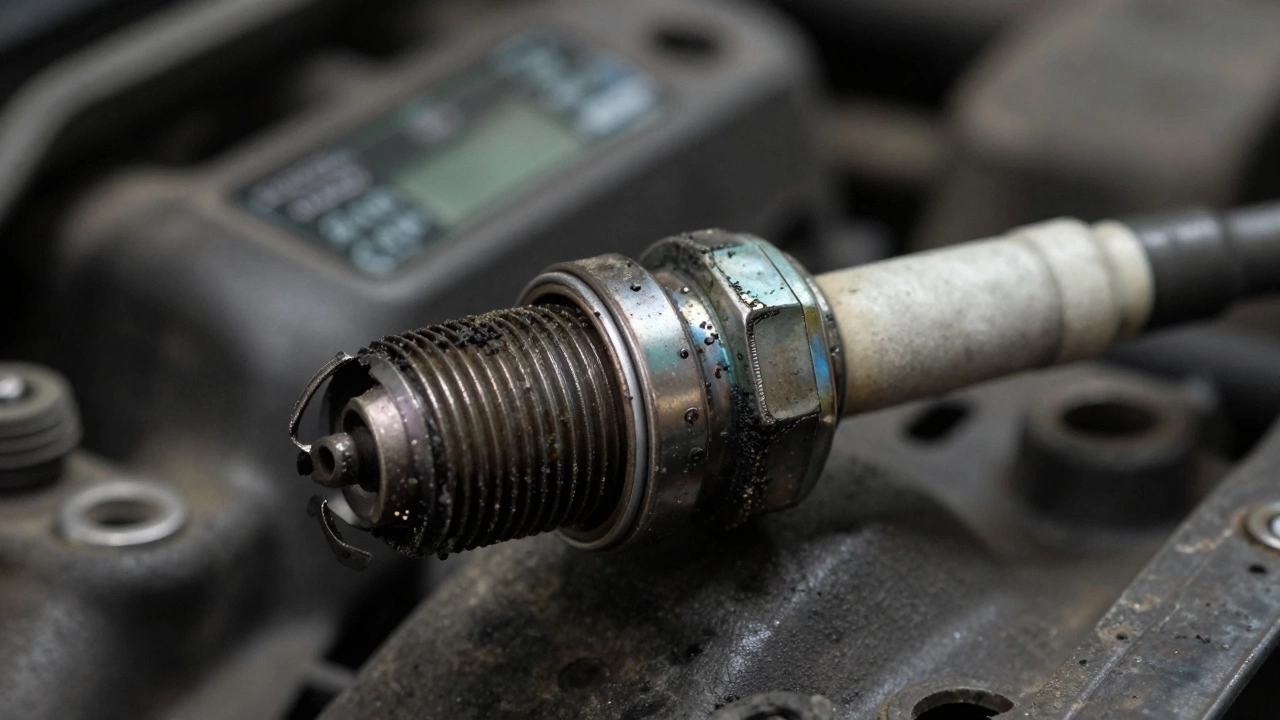
If you’ve ever pulled out a spark plug, you know they tell a story. A healthy plug has a light tan or grayish deposit on the electrode. A bad one looks like this:
- Black, sooty deposits → rich fuel mixture or long-term neglect
- White or blistered electrodes → overheating from wrong plug heat range or timing issues
- Oily, wet electrodes → leaking valve seals or piston rings letting oil into the combustion chamber
- Cracked porcelain → physical damage from improper installation or engine knock
- Worn or eroded electrodes → normal wear after 80,000+ miles (but many cars need replacement by 60,000)
Most manufacturers recommend replacing spark plugs every 60,000 to 100,000 miles. But if you drive short trips in freezing weather-like most people in Hamilton-your plugs wear out faster. Short trips don’t let the engine reach full operating temperature, so carbon builds up instead of burning off.
What to do if you suspect bad spark plugs
Don’t guess. Test. Here’s a simple checklist:
- Check your owner’s manual for the recommended replacement interval.
- Listen for rough idling or hesitation when accelerating.
- Watch your fuel economy-has it dropped noticeably in the last 2,000 miles?
- Use an OBD2 scanner (many auto parts stores offer free checks) to see if misfire codes are stored.
- If you’re comfortable, pull one plug and inspect it. A quick look can tell you more than any code.
If any of these signs are present, replace the plugs. Don’t wait for the engine to fail. Use the correct type-NGK, Denso, or Champion-matching your car’s specs. Don’t buy the cheapest set. Cheap plugs can fail faster and cause more damage.

How often should you replace spark plugs?
It’s not one-size-fits-all. Standard copper plugs last 20,000 to 30,000 miles. Platinum plugs last 60,000 to 100,000. Iridium plugs-the best for performance and longevity-can go 100,000 to 120,000 miles. But again, driving habits matter. If you’re doing mostly city driving, stop-and-go traffic, and short trips in winter, replace them at 50,000 to 60,000 miles, no matter what the manual says. Cold starts are brutal on plugs. Moisture and unburned fuel cling to them. They foul faster.
What happens if you ignore it?
Ignore bad spark plugs long enough, and you’ll face one of three outcomes:
- Costly catalytic converter failure → $1,500+ repair
- Engine misfire damage → bent valves, damaged pistons, or cylinder scoring
- Stranded on the side of the road → engine suddenly dies and won’t restart
None of these are worth the risk. Spark plugs are one of the cheapest, easiest fixes in car maintenance. Skipping them saves you pennies now but costs you dollars later.
Bottom line: Replace them before they break you
Bad spark plugs don’t just make your car run poorly-they make it unsafe and expensive. If you’re noticing any of the symptoms-rough idle, poor acceleration, bad gas mileage, or a check engine light-it’s not time to wait. It’s time to act. Replacing spark plugs is a simple job you can do yourself in under an hour with basic tools. Or pay a shop $120 to $180. Either way, it’s a fraction of what you’ll pay if you wait too long. Your engine will thank you. So will your wallet.